
Let’s ditch basic profiles and reveal hyper-personalization in high-stakes negotiations by utilizing AI, real-time data, and emotional intelligence.
We create offers that respond instantly to shifting moods, hidden motives, and undisclosed bottom lines, enhancing trust and closing deals more quickly.
Imagine identifying subtle anger or happiness cues to tailor your pitch perfectly, that’s game-changing.
Beyond avatars, we build energetic, predictive connections that adjust fluidly, ensuring negotiation success like never before.
Stick with us, and you’ll discover the secrets to mastering this powerful approach.

Key Takeaways
- Integrate real-time data and AI to create fluid, predictive profiles that adapt to shifting negotiation dynamics and reveal hidden motivations.
- Use emotional intelligence to recognize nonverbal cues and emotional triggers, enhancing trust and collaborative deal-making in high-stakes environments.
- Move beyond static profiles by continuously updating insights to capture counterparties’ changing BATNAs and walk-away points for strategic advantage.
- Tailor offers hyper-personally by aligning pricing, communication channels, and timing with individual sensitivities and preferences for greater acceptance.
- Measure hyper-personalization impact via metrics like revenue growth, customer retention, acquisition cost reduction, and conversion rate improvements to validate strategies.
What Hyper-Personalization Means in High-Stakes Negotiations
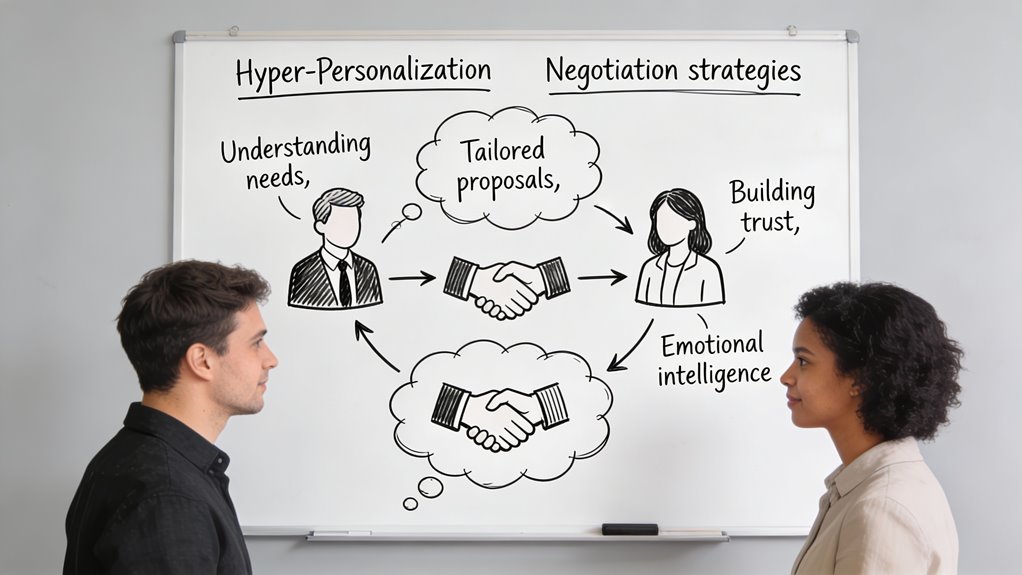
Imagine the following: you’re entering a high-stakes negotiation where every detail matters, and a one-size-fits-all method just won’t suffice. Hyper-personalization alters the game by utilizing data integration to unify various data streams, consider browsing behavior, location, and real-time environment, into a single, fluid profile. This fuels tailored engagement that’s predictive and flexible, not merely reactive. It prioritizes customer- and partner-centric communications to ensure every interaction delivers true value. Recent studies show synthetic media can significantly boost engagement, resulting in improved close rates.
Picture AI anticipating a partner’s needs mid-discussion, altering incentives instantly based on their unique business objectives. This isn’t surface-level customization; it’s a strategic choreography fueled by real-time analytics and machine learning, producing precise, relevant communications at every touchpoint. When we welcome hyper-personalization, we don’t just negotiate, we innovate, creating client relationships built on trust, understanding, and laser-focused value that genuinely shifts the needle.
Why Simple Counterparty Profiles Don’t Cut It
We know that relying on simple counterparty profiles misses the full portrayal, since people and situations are continually developing. Basic snapshots overlook the complex behaviors and shifting risks that play out in real time, from sudden market swings to hidden contractual quirks. Counterparty risk encompasses the possibility that the opposing party may fail to fulfill their contractual obligations, which can lead to significant losses if not properly managed counterparty risk. To truly excel in high-stakes negotiations, we need energetic insights that capture these layers and help us stay one step in front.
Limitations Of Basic Profiles
Many negotiators fall into the trap by relying on basic counterparty profiles, but those simplistic snapshots barely scratch the surface regarding what’s really happening. Profile limitations become glaring when we realize that hidden motives, undisclosed bottom lines, and unknown BATNAs (Best Alternative to a Negotiated Agreement) shape negotiation interactions in ways a bare-bones dossier can’t reveal. Understanding the counterparty’s real motivations can provide crucial leverage that simple profiles overlook.

Without digging deeper, we miss critical vulnerabilities and strategic priorities lurking beneath the surface. Imagine negotiating blindfolded, this is fundamentally what basic profiles force us to do, increasing risks and reducing flexibility. To innovate and thrive, we need tools that disclose these intricacies, offering real-time understandings and a refined comprehension. Only then can we move beyond guesswork and excel in hyper-personalization in high-stakes negotiation environments.
Complexity Of Human Behavior
Although simple counterparty profiles give us a starting point, they barely scratch the surface of what truly drives human behavior in negotiations. People are shaped by invisible psychological structures that influence decisions unconsciously, making negotiations a dance of cognitive biases and emotional intelligence rather than cold logic alone. Awareness of these psychological frameworks differentiates negotiating with people versus negotiating with their psychology.
For instance, under cognitive load, negotiators tend to default to safe, familiar choices, hardly ideal for innovative deals. Emotional intelligence helps us read these subtle signals, anger hinting at limits, or positive moods nurturing cooperation, allowing us to adjust on the fly. Negotiation isn’t just about who someone is on paper; it’s about understanding the rich, evolving interaction of biases, emotions, and personalities that push or pull toward agreement. Let’s move beyond avatars and accept this complexity to truly excel in hyper-personalization.
Need For Dynamic Insights
Why settle for simple counterparty profiles when the stakes and variables shift more rapidly than we can blink? Static snapshots miss hidden motivations and developing risk profiles, think of it like trying to steer through a storm with yesterday’s weather report. We need innovative revelations that capture real-time adjustments, revealing true objectives beyond surface data.
For instance, credit exposures can morph dramatically within hours, demanding immediate rating updates and collateral recalculations. Without such agility, limit managers risk poor decisions, delayed negotiations, and costly fallout. By embracing frontier technology systems and continuous data integration, we reveal walk-away points, BATNAs, and zones of possible agreement that static profiles simply overlook. Let’s turn negotiation into a precise dance of understanding and timing, where real-time revelations shape smarter, quicker, and more customized dealmaking every step of the way.
Using Data and AI to Negotiate Smarter
When we employ the power of data and AI in negotiations, we reveal a whole new dimension of strategic advantage that traditional methods simply can’t match. Machine learning hones negotiation tactics by analyzing vast amounts of historical data, predicting counterparty moves, and automating contract reviews with unmatched precision. Imagine slashing contract lifecycles by nearly 40% and cutting costs by 40%, results real teams achieve daily thanks to AI-driven revelations. Integrating synthetic media into sales workflows can further revolutionize these processes by enabling hyper-personalized, scalable communication strategies that enhance engagement and efficacy.
Reading Emotional and Behavioral Signals in Negotiations
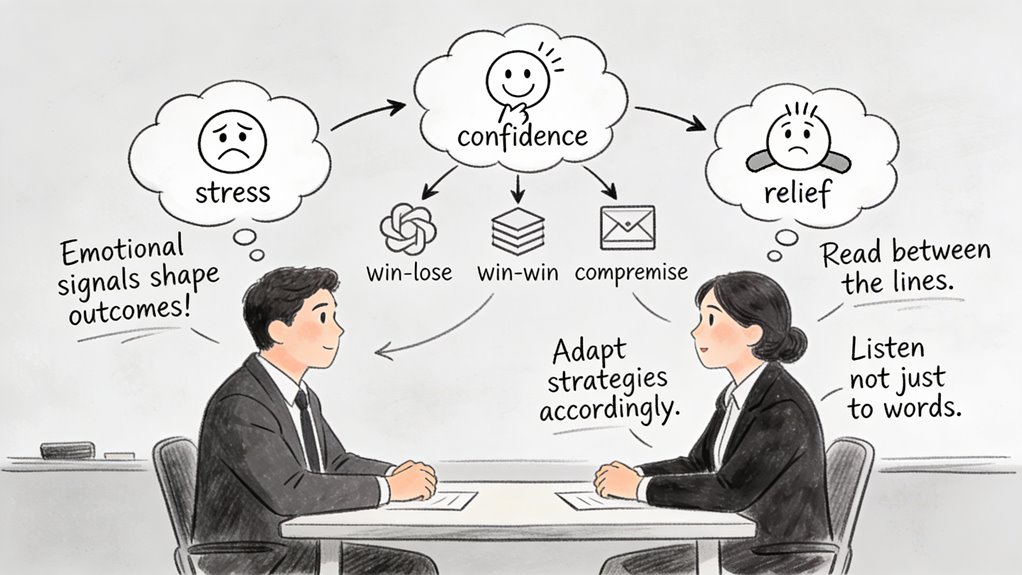
Let’s sharpen our ability to read emotional and behavioral signals, because identifying a flicker of frustration or a subtle smirk can radically shift the negotiation’s outcome. By decoding nonverbal cues, recognizing emotional triggers like strategic anger or genuine happiness, and adjusting to changes in behavior, we gain the upper hand without saying a word. It resembles having a secret negotiation radar that tells us when to press, pause, or pivot, mastering such a skill is the real breakthrough.
Decoding Nonverbal Cues
How often do we overlook the silent language that speaks louder than words in negotiations? By excelling at nonverbal subtleties, especially body language, we gain a powerful edge. Facial expressions alone convey 55% of impact, with smiles building rapport and frowns signaling opposition. Posture, too, accounts for up to 55% of communication, where leaning forward invites engagement.
Eye contact—maintained ideally 60-70% of the time—breaks barriers, while gestures and space reflect dominance or collaboration.
| Nonverbal Cue | Signal | Impact |
|---|---|---|
| Facial Expressions | Smile, Frown | Build rapport, show resistance |
| Posture | Lean forward, relaxed | Engagement, trust |
| Eye Contact | Steady, gaze aversion | Rapport, disagreement |
| Gestures | Nods, expansive gestures | Agreement, dominance |
| Use of Space | Occupying more space | Power projection |
Decoding these signals alters negotiations, let’s tune in!
Recognizing Emotional Triggers
Nonverbal cues give us powerful perceptions, but emotional triggers tap even further into the negotiation interactions, revealing the hidden currents shaping decisions. By sharpening our emotional awareness and trigger recognition, we decode what lies beneath the surface, authentic anger prompting bigger concessions or genuine happiness signaling satisfaction, curbing compromise.
We can use these revelations strategically, like:
- Authentic anger signals a high reservation price, nudging us to adjust offers smartly.
- Happiness often masks competitive intent, so fewer concessions predicted.
- Mixed emotions spark creativity, leading to innovative deals beyond zero-sum limits.
- Recognizing incidental emotions means we avoid misjudgments and keep focus.
Harnessing emotional triggers alters negotiations into vibrant dialogues where intuition and intellect fuse, revealing unparalleled outcomes. Let’s become proficient in this subtle art together, advancing beyond surface-level tactics.
Adapting To Behavioral Changes
Because negotiations are fluid and constantly evolving, adjusting to behavioral changes is crucial for achieving expertise in the art of persuasion. Embracing behavioral flexibility means reading emotional signals, like a subtle frown or sudden smile, and tweaking our strategies in real time.
Emotional resilience helps us stay steady amid these shifts; it is our secret ingredient against negative emotions that cause roadblocks. Take anger, for example: while it can push concessions, we must read its authenticity carefully. Genuine anger signals high limits, but fake anger might backfire. Positive emotions open the door to collaboration, building trust and enabling joint gains. By honing these skills, we create a responsive feedback loop, turning every negotiation twist into an opportunity to innovate and win, proving that mastering emotions is truly the cutting edge in high-stakes deal-making.
Crafting Hyper-Personalized Offers That Persuade
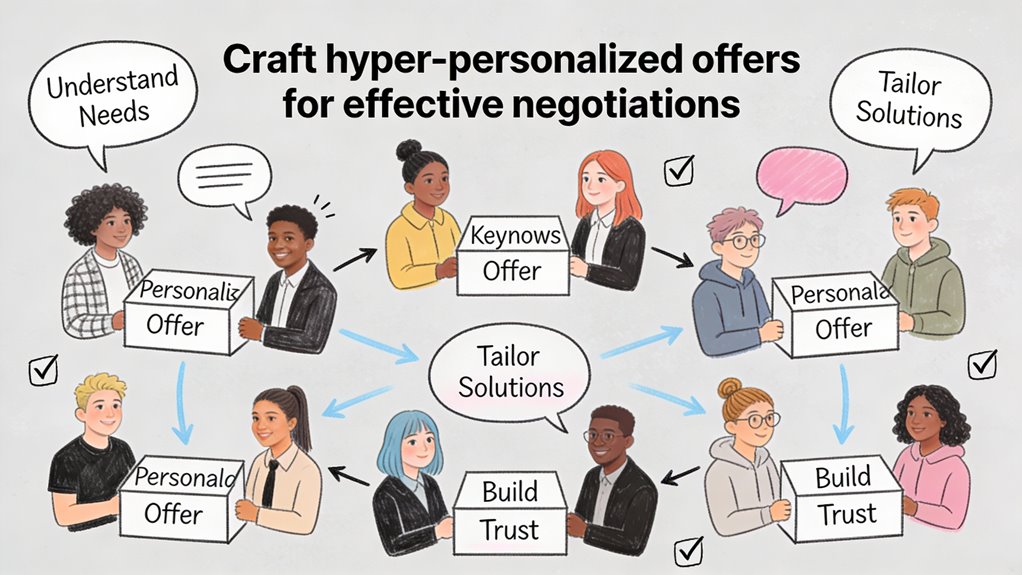
Anyone looking to persuade in negotiations can’t afford to rely on one-size-fits-all offers anymore. Customized negotiations demand powerful, persuasive strategies that utilize hyper-personalization, using real-time data, customer behavior, and predictive analytics to create offers that truly connect. Here’s how we nail it:
Effective negotiation today demands hyper-personalized strategies powered by real-time data and predictive insights.
- Customize pricing based on individual sensitivity, enhancing both revenue and satisfaction.
- Choose communication channels and timing aligned with client preferences to optimize engagement.
- Customize offer presentations: tone, visuals, and complexity, to match the customer’s profile for smoother decisions.
- Continuously adjust offers fluidly as the negotiation and client feedback evolve.
- Leverage mass messaging personalization to send thousands of tailored messages without sacrificing the individual connection.
Building Rapid Trust With Tailored Communication
While hyper-personalized offers can open doors, building rapid trust with customized communication is what turns negotiations into partnerships. It is about relationship building through savvy communication strategies like active listening: asking thoughtful questions and paraphrasing to demonstrate respect and clarity. Starting with rapport instead of demands establishes a shared vision. This makes conversations feel less like battles and more like mutual quests.
Customizing language and acknowledging cultural subtleties signal genuine commitment, while following through regarding small promises cements reliability. Remember, trust isn’t just earned over months, it can spark in minutes when we listen thoroughly and respond empathetically. By excelling at these customized communication strategies, we don’t just innovate; we create negotiation ecosystems where all parties feel heard, valued, and ready to collaborate. Ready to make trust your secret weapon? Let’s immerse ourselves.
Adapting Negotiation Strategies in Real Time
As negotiations unfold, modifying our strategies in real time is not just a nice-to-have, it is a game changer that separates good negotiators from great ones. Embracing real time adjustments, we utilize AI-driven perspectives and versatile strategies to stay several moves ahead.
Imagine shifting tone and pace virtually when body language cues vanish or recalibrating compromise speed based on opponent profiling. Here’s how we master this:
- Use AI for instant feedback and opponent behavior predictions.
- Tailor communication flexibly with personality data analysis.
- Adjust virtual cues like eye contact and affirmations to build connection.
- Manage time pressure by scheduling thoughtful, unhurried sessions.
We also empower negotiation teams by integrating AI-driven creative services to automate and amplify strategic communication efforts.
Avoiding Trust and Data Overload Pitfalls
Since trust forms the foundation for every successful negotiation, we cannot afford to let hyper-personalization backfire by crossing privacy limits or overwhelming with data. We must integrate trust building techniques that emphasize transparency, giving counterparts a clear understanding of how we use their data. Data privacy measures, like granular consent and evolving controls, enable individuals without making them feel “watched.”
Measuring Hyper-Personalization’s Impact on Deal Outcomes
Whenever we welcome hyper-customization in negotiations, it is crucial to measure just how much impact our individualized strategies have regarding deal outcomes. Tracking impact metrics lets us pinpoint success factors that truly fuel growth and negotiation victories.
For instance, customized approaches can enhance revenue by up to 15%, reduce acquisition costs by 50%, and drive conversion rates by over 200%. To stay ahead and innovate, let us focus on these key impact metrics:
- Revenue growth tied directly to personalized engagement
- Customer retention improvements and loyalty shifts
- Acquisition cost reductions through precision targeting
- Conversion rate increases via tailored calls-to-action
Data comparing manual vs. synthetic sales video outreach reveals valuable insights that can guide the optimization of hyper-personalized strategies in negotiations.
Frequently Asked Questions
How Do Cultural Differences Affect Hyper-Personalized Negotiation Tactics?
We know cultural subtleties shape negotiation styles, so we adjust hyper-personalized tactics by blending direct and indirect communication, balancing integrative and distributive approaches, and leveraging curiosity in order to innovate trust-building in diverse, high-stakes negotiations.
What Ethical Concerns Arise From Using Ai-Driven Personalization in Negotiations?
We see manipulation risks and consent issues as ethical challenges in AI-driven personalization during negotiations. Let’s champion transparency and user control to guarantee innovation respects autonomy and cultivates trust, avoiding exploitative or opaque practices.
Can Hyper-Personalization Techniques Be Applied in Virtual or Remote Negotiations?
Yes, we can utilize hyper-personalization in virtual environments by integrating remote strategies like AI-driven real-time modification and multi-agent systems, enabling us to tailor negotiations flexibly, enhance engagement, and drive innovative, smooth remote interactions.
How Do Negotiators Balance Data Privacy With Personalization Needs?
We balance data privacy with personalization needs by prioritizing data transparency, addressing privacy concerns openly, and leveraging AI-driven anonymization techniques. In this manner, we innovate responsibly while building trust and providing customized negotiation experiences.
What Training Is Required to Develop Hyper-Personalization Skills in Negotiation Teams?
We need role-playing exercises that simulate real negotiations, integrating emotional intelligence training to interpret cues and modify quickly. This hands-on approach guarantees our teams innovate consistently with genuine hyper-personalization skills in fluid negotiation environments.