
We know creative fatigue kills DTC ad performance quickly, when ads repeat too often, engagement tanks and budgets waste away. The solution? Fresh weekly creatives, smart ad rotation, and frequency caps to keep audiences engaged without burnout.
Leveraging AI accelerates new ad launches, while raw, authentic content builds trust and stands out more than polished placements.
Combine these tactics with flexible workflows, and you’ll keep your brand lively and conversions climbing.
Stick around to reveal how top brands maintain this momentum going strong.

Key Takeaways
- Rotate diverse creative assets weekly to prevent audience overexposure and maintain engagement in DTC advertising campaigns.
- Use AI-powered automation for rapid ad creation, messaging adaptation, and efficient multi-channel campaign management.
- Implement smart frequency caps (3-5 impressions weekly) and audience segmentation to reduce banner blindness and ad fatigue.
- Prioritize raw, authentic content to build trust, increase click-through rates, and improve organic algorithm visibility.
- Establish centralized workflows with fatigue detection and performance tracking to ensure proactive creative refreshes and maximize ROAS.
What Causes Creative Fatigue in DTC Advertising
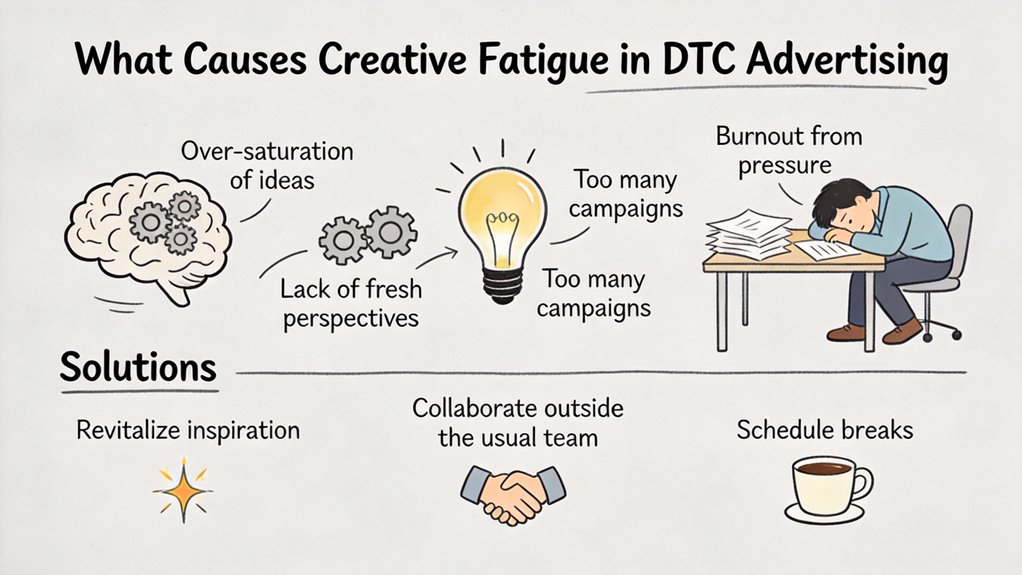
Every digital marketer who’s worked with DTC brands knows the frustration: no matter how brilliant your initial ad creative is, its power fades quickly if you depend on it too long. The culprit is overusing single creative assets without renewing your content. Even the best-performing ads lose spark after audiences see them repeatedly. Meta’s research shows click likelihood plummets about 45% after just four exposures. This decline in performance is a clear example of ad creative fatigue, where repeated exposure causes dropping engagement and effectiveness.
Narrow audience segmentation worsens this, as small pools get bombarded with the same visuals, inflating costs and stalling reach. Without smart creative rotation and continuous monitoring of performance metrics, engagement inevitably drops. To stay ahead, we must welcome innovation in creative strategy, regularly rotate assets, and segment audiences wisely, because stale ads simply don’t cut it in today’s rapid DTC environment. Leveraging manual vs. synthetic sales video outreach can also optimize the freshness and appeal of your creative assets.
How Creative Fatigue Wastes Budget and Performance
When ad creatives lose their freshness, that isn’t just your audience’s interest that takes a hit, your budget and overall campaign performance suffer also. Creative fatigue burns precious ad spend, with 23% of impressions wasted due to overexposure. It slashes engagement rates by 15% over just three months, making your carefully designed creative strategies ineffective. Leveraging scalable video content solutions can help retail brands maintain creative momentum without overwhelming their resources.
When ad creatives lose freshness, audience interest, budget, and campaign performance all take a significant hit.

Audience segmentation loses power when repetitive ads cause 55% of consumers to tune out, dragging down conversions by up to 49%. Moreover, excessive ad exposure has been shown to transform engagement into irritation, further harming campaign outcomes.
Here’s how creative fatigue wastes resources:
- Dropping click-through rates by 40%, undermining ROI
- Reducing remarketing effectiveness by 30%, losing sales opportunities
- Driving 70% of millennials to block ads, shrinking reach
- Triggering 20% brand trust erosion, compromising long-term growth
Let’s innovate smarter, not harder, to keep creativity alive and budgets well-spent.
Why Weekly Creative Refreshes Are Essential
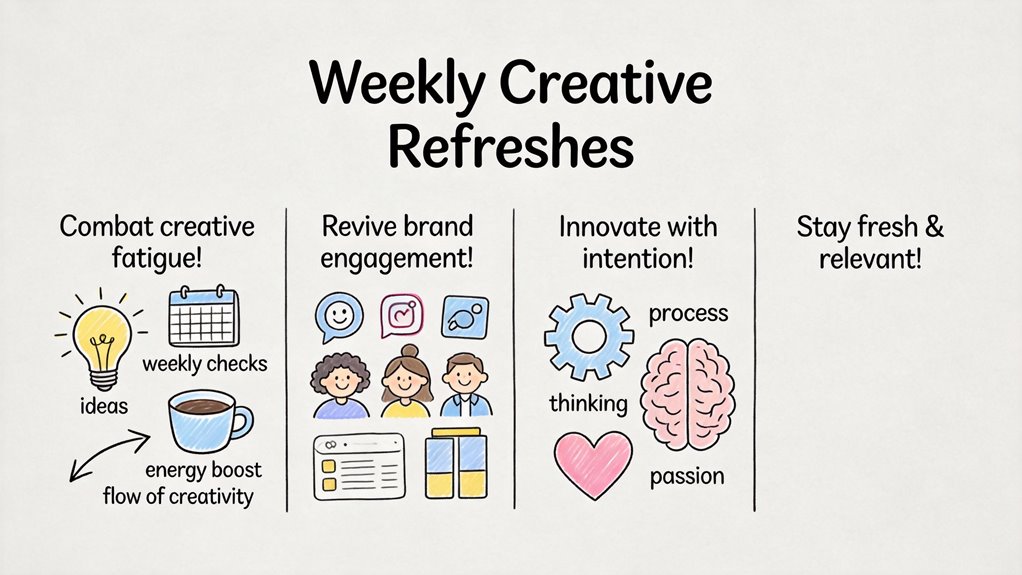
Let’s plunge into why weekly creative overhauls are a breakthrough for your digital campaigns, we’re not just swapping images here; we’re keeping your brand front and center in a sea of content that’s updated at lightning speed. Platforms like Facebook and TikTok demand fresh creatives weekly to counteract rapid audience shifts and the constantly changing creative trends dominating their feeds. Leveraging AI automation to provide high-volume creative services can streamline this refresh process, making it efficient and scalable. When ads repeat more than three times, performance plummets—engagement and clicks drop like flies. Consistent refreshing is vital to maintaining viewer interest and avoiding ad fatigue.
Why Broken Workflows Hold Back Your Creative Speed
We all know how frustrating it is when broken workflows turn simple tasks into time-consuming marathons, draining the creative energy we need most. When coordination drags along and manual handoffs pile up, our speed grinds to a halt. This leaves fresh ideas stuck in limbo. In fact, studies show that 60% of employees could save 30% of their time with workflow automation, proving how much potential there is to reclaim creative capacity. Integrating synthetic media into sales workflows can further streamline these processes and boost creative speed.
Let’s investigate how streamlining these bottlenecks not only saves hours but accelerates our creative output across the board.
Workflow Inefficiency Impact
Though creativity fuels our brand’s unique voice, broken workflows silently throttle our creative pace, turning inspired ideas into bottlenecked projects. Workflow bottlenecks cause frustrating creative delays, slowing down content creation and stifling innovation. When processes get tangled, even the brightest ideas lose momentum.
Here’s how workflow inefficiency impacts us:
- Disconnected workstreams lead to miscommunication and duplicated effort, dragging out timelines.
- Manual handoffs introduce errors, forcing constant rework and draining energy.
- Lack of integration between marketing tools causes crucial content to stall dangerously.
- Print-focused legacy processes clash with digital demands, limiting agility and scale.
To innovate and quicken, we must untangle these inefficiencies, altering broken workflows into a speedy lane for creativity.
Coordination Time Drain
When coordination drags, creativity stalls, it’s that simple. Broken workflows and unclear communication channels create a massive coordination time drain that saps our creative speed. Overloaded meetings, many ad hoc and spanning time zones, soak up hours that should fuel innovation.
We can reclaim that time by enhancing meeting efficiency and integrating smarter collaboration tools that clarify roles and optimize communication.
| Issue | Cause | Fix |
|---|---|---|
| Excessive meetings | Over-reliance, poor planning | Set agendas, limit attendees |
| Miscommunication | Undefined channels | Use unified platforms |
| Role ambiguity | Lack of shared knowledge | Centralize information |
| Ad hoc scheduling | Last-minute invites | Schedule with intent |
| Cross-functional delays | Complex structures | Simplify workflows |
Let’s cut coordination costs and spark creativity together.
How AI Helps You Create Ads Faster to Beat Fatigue
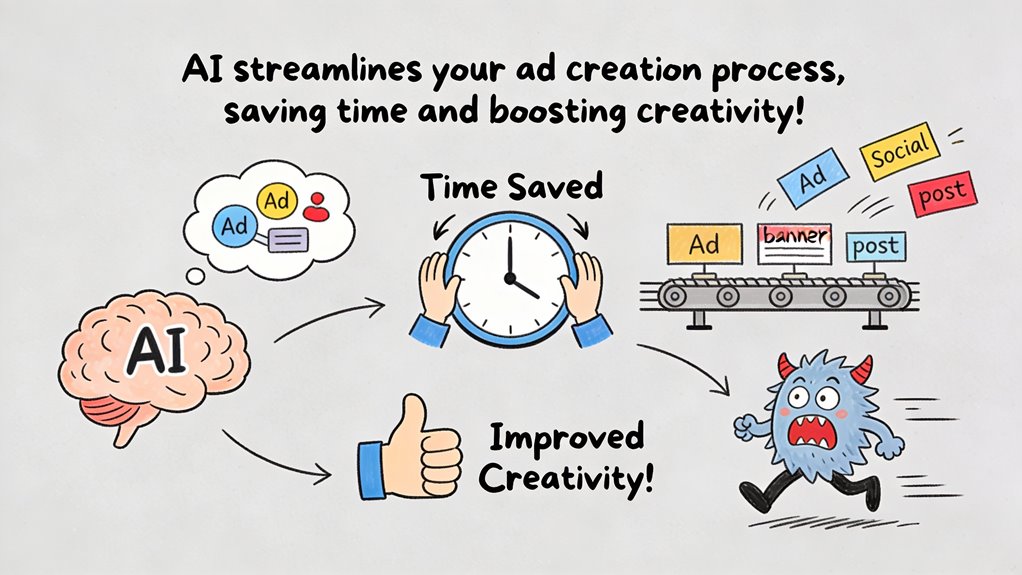
Since speed is everything in today’s rapid market, using AI to create ads more swiftly isn’t just a luxury, it’s a game changer for overcoming creative fatigue. AI Ad Creation and Creative Automation enable us to launch campaigns 75% quicker by streamlining data analysis, content generation, and real-time optimizations.
Here’s how it fuels our innovation:
- AI autonomously generates and evolves ad messaging, matching brand tone adaptively.
- Complex multi-regional campaigns get managed effortlessly by AI’s validated targeting and budget adjustments.
- Predictive models hyper-personalize ads across channels, enhancing engagement and conversions.
- Routine tasks like reporting and segmentation get streamlined, freeing creative energy for strategy.
By leveraging AI, agencies can streamline workflows significantly and produce hundreds of client ads with much greater efficiency.
Why Raw and Authentic Content Outperforms Polished Ads
While polished ads might amaze with slick visuals and perfect lighting, raw and authentic content wins hearts by sparking genuine connections that polished perfection often overlooks. Raw authenticity builds trust. Consumers prefer unpolished engagement like shaky founder videos over scripted perfection.
This realness yields up to 4x higher Instagram engagement and elevates click-through rates by 4 times compared to glossy ads. Additionally, algorithms reward native, unfiltered content, pushing visibility and interaction sky-high. Let’s visualize this with key data:
| Aspect | Polished Ads | Raw & Authentic Content |
|---|---|---|
| Trust Level | Moderate | High |
| Engagement | Low to Moderate | 4x Higher |
| Algorithm Elevation | Limited | Prioritized |
| Cost Efficiency | High Production Cost | Low, Phone-shot Content |
| Conversion Impact | Average | Significant Lift |
Embracing raw authenticity alters fatigue into fresh, relatable storytelling.
Optimizing Ad Rotation and Frequency Capping to Reduce Fatigue
Authentic, raw content grabs focus and builds trust, but even the most enchanting creative can lose its sparkle if viewers see them too often. That’s where optimizing ad rotation and frequency capping comes in to save the day. By fine-tuning frequency metrics and leveraging audience segmentation, we guarantee our ads stay fresh and effective without overwhelming potential customers.
Here’s how we innovate:
- Rotate multiple creatives sequentially, designing stories that engage and evolve.
- Set smart frequency caps, like 3-5 impressions weekly, to avoid banner blindness.
- Use AI-driven observations to modify caps based on user behavior and recency.
- Coordinate frequency across channels to maintain message harmony and impact.
This approach not only fights fatigue but amps up engagement, keeping campaigns lively and ready to convert.
How Top DTC Brands Structure Workflows to Beat Creative Fatigue
When we look at the playbooks of top Direct-to-Consumer (DTC) brands, it is clear that beating creative fatigue isn’t left to chance, it is engineered through smart, improved workflows. They kick off campaigns with diverse creative assets—multiple visuals, headlines, and CTAs—setting a strong foundation for testing and enhancing audience engagement.
Automation tools like Energetic Creative Optimization constantly refresh content based on real-time metrics, freeing teams to focus on innovation. Centralizing asset management with AI guarantees clear feedback loops and rapid iteration, while early detection systems catch fatigue before it drags performance down. Here’s a glimpse:
| Workflow Element | Benefit |
|---|---|
| Launch Creative Diversity | Prevents early overexposure |
| Energetic Creative Optimization | Maximizes engagement automatically |
| Centralized Asset Management | Speeds feedback and iteration |
This combo of creative strategies is how they stay fresh, nimble, and audience-focused.
Measuring and Improving Creative Velocity for Sustained Growth
Since launching fresh creative assets consistently improves performance, measuring and improving our creative velocity becomes a breakthrough for sustained growth. Creative velocity, how quickly we produce and launch new ads, is a game changer, especially when paired with precise creative testing and sharp audience targeting.
To innovate and stay ahead, let’s focus on these four crucial elements:
- Track cycle time and throughput to identify bottlenecks slowing ad launches.
- Use fatigue metrics to rotate creatives proactively, preventing audience burnout.
- Utilize AI-powered tools for swift production, accelerating image and video creation.
- Align creative output with real-time performance data, maximizing ROAS and reducing CAC.
Together, these steps fuel consistent innovation, letting us launch multiple new creatives weekly, keeping users engaged and growth sustainable.
Frequently Asked Questions
How Does Consumer Ad Fatigue Affect Brand Loyalty and Word-Of-Mouth?
We know ad fatigue harms brand loyalty and word-of-mouth by worsening ad perception and reducing brand engagement. That’s why we’ve got innovate, creating fresh, relevant content that keeps consumers excited and connected with us.
What Role Does Multi-Platform Ad Strategy Play in Managing Creative Fatigue?
We know multi-platform engagement fuels innovation by spreading ads across channels, preventing burnout. Combining ad variation strategies lets us tailor content, keeping audiences fresh and responsive, so we stay ahead in fatigue and maximize brand impact together.
Are There Specific Creative Formats Proven to Reduce Consumer Ad Fatigue?
We’ve found video ads and carousel posts dramatically reduce consumer ad fatigue by keeping content lively and engaging. Mixing these formats helps us innovate continuously and hold audience focus, making experiences feel fresh and less repetitive.
How Do Budget Sizes Impact the Frequency of Creative Refreshes Needed?
We know budget constraints dictate our creative strategy—higher budgets push us toward frequent refreshes to enhance spend, while tighter resources demand extended cycles with precise data monitoring. Let’s innovate by tailoring refreshes according to budget realities.
Can Influencer-Generated Content Alleviate Creative Fatigue in DTC Advertising?
Yes, we can alleviate creative fatigue by leveraging influencer authenticity and content diversity. Their genuine voices and varied formats keep our ads fresh, engaging, and innovative, helping us continuously plunge into audiences in meaningful ways.