
When we compare Pencil AI and Hookfoundry for lead generation, Pencil AI shines with intelligent AI-driven ad creation, smooth email and LinkedIn integrations, and user-friendly workflows designed for quick, customized outreach.
Hookfoundry offers solid B2B data augmentation and flexible scoring but falls short in automation and transparency.
If you seek scalable, AI-enhanced sequences that pack a punch with minimal setup, Pencil AI’s your go-to.
Stick around, because we’ve got more profound understandings regarding selecting the right toolkit for your growth objectives.

Key Takeaways
- Pencil AI excels in AI-driven ad creative generation with predictive performance scoring, enhancing lead engagement through automated, personalized multi-channel campaigns.
- Hookfoundry focuses on enriched lead data via multi-source waterfall enrichment and flexible lead scoring for improved qualification accuracy.
- Pencil AI supports seamless CRM integrations and real-time lead syncing, boosting workflow automation and efficiency in outreach efforts.
- Hookfoundry lacks transparent pricing and advanced AI tools, making it less accessible for users prioritizing rapid, high-volume lead generation.
- Choose Pencil AI for scalable, AI-enhanced email and LinkedIn sequences; opt for Hookfoundry when deep B2B data enrichment and multi-channel personalization are critical.
Differences in Lead Generation: Pencil AI vs Hookfoundry
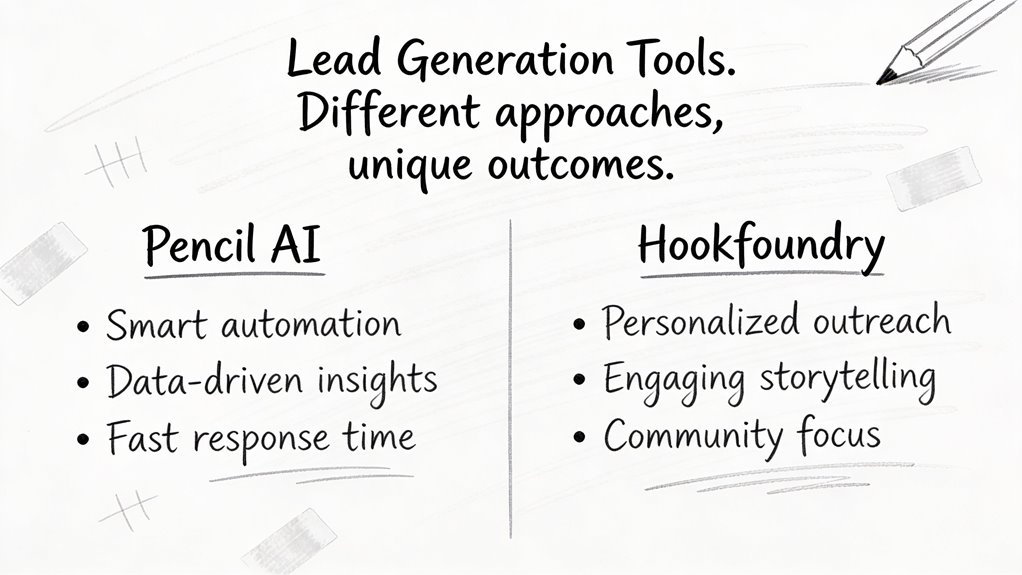
While both Pencil AI and Hookfoundry endeavor to improve lead generation, they take strikingly different paths to achieve that, and that’s what makes comparing them so fascinating. Pencil AI leans into creative generation, using sophisticated data analysis from over a billion dollars in ad spend to predict ad performance before launch. This means its lead capture is indirect, focusing on driving engagement through lively ad variation across major platforms like Facebook and TikTok. Its approach helps brands build professional video content at massive scale, further boosting engagement potential.
Hookfoundry, on the other hand, zeroes in on direct lead capture by augmenting data from over 30 sources, automatically filling gaps to create high-quality, action-ready leads. Its waterfall enrichment strategy reduces guesswork and cleanses data effortlessly, giving teams a sharper edge. For innovators craving innovative lead capture fueled by data-driven understanding, comprehending these differences is essential. Additionally, platforms like UpLead enhance lead accuracy with their real-time data verification, ensuring that marketing efforts target the most reliable contacts available.
Comparing Email and LinkedIn Prospecting Approaches
Let’s compare email and LinkedIn prospecting, each offers unique personalization tricks and distinct targeting advantages that shape lead quality and engagement. Email lets us scale quickly with automation and broad reach, while LinkedIn shines with rich profile data and real-time signals, making connections feel more human and trusted. For example, LinkedIn has average reply rates of 20-45% for well-targeted InMail, demonstrating higher engagement than cold emails.
Email Versus Social Outreach
Because connecting with prospects can make or break a campaign, choosing the right outreach method deserves our full focus. When we talk Email Engagement, scalability shines, as targeted campaigns reach thousands quickly, with 35-60% open rates. Yet, LinkedIn Effectiveness impresses with reply rates soaring to 20-45% via InMail, thanks to rich profile knowledge and shared connections.

Response Timing varies: LinkedIn often yields quicker, warmer responses, while Email relies on Frequency Optimization to avoid spamming. Additionally, maintaining a clear call to action in emails is essential for guiding recipients toward desired responses. Audience Segmentation and Message creation pair beautifully with Email’s automation, but Strategy Alignment demands awareness of Platform Limitations: LinkedIn’s manual work and spam filters on cold emails can bite. For lead gen innovators, a smart mix guides these pros and cons, pushing outreach beyond basics to reveal real growth.
Personalization Techniques Comparison
How do personalization techniques stack up when comparing email and LinkedIn prospecting? Email personalization utilizes AI to create customized sequences and behavior-based messaging, enhancing outreach effectiveness through lead filtering and inbox warm-up, think of it as a well-oiled machine fine-tuning each sound for ideal impact. In addition, email tools often focus on high email deliverability to ensure outreach reaches the right audience reliably.
On the flip side, LinkedIn capitalizes on rich, GDPR-compliant data and recent social signals to generate AI-driven prospecting messages, making personalization impact feel more human and timely. Both excel, yet their strengths differ: email shines with data-driven sequencing and deliverability optimization, while LinkedIn thrives on situational, socially enhanced engagement. By mastering these platforms’ unique personalization techniques, we amplify lead gen efforts, ensuring our outreach not only reaches prospects but connects profoundly, innovation that’s personal, precise, and ready for conversion.
Platform Targeting Advantages
While both email and LinkedIn prospecting bring unique advantages to the table, understanding their platform targeting differences helps us sharpen our lead gen strategies and win more conversions. Pencil AI’s email focus truly stands out, with mechanized sequences, real-time lead syncing, and deliverability tools, all enabling us to engage our target audience with precision.
Its rich campaign analytics let us enhance our content strategy flexibly. In contrast, LinkedIn prioritizes CRM-native workflows and intent signals, great for situation-rich prospecting but less mechanized. Hookfoundry falls short in both email and LinkedIn arenas, lacking sturdy integrations and AI-driven tools. So, if innovation drives us, embracing Pencil’s email-centric approach accelerates lead nurturing and amplifies conversions, while LinkedIn’s strengths complement where profound relationship-building matters most.
AI Personalization for Lead Generation: Pencil AI vs Hookfoundry
AI personalization is transforming how we approach lead generation, and when considering tailoring ads with precision, Pencil AI stands out brilliantly. By leveraging smart personalization strategies and detailed audience segmentation, Pencil AI creates behavior-based messaging that fluidly adjusts to individual user data. Its generative AI designs countless ad variations supported by predictive performance scoring, ensuring each creative hits the mark before launch.
In contrast, Hookfoundry lacks documented AI-driven personalization features or the advanced workflows needed to tailor ads at scale. For innovators seeking to uplift lead gen through hyper-targeted, data-backed campaigns, Pencil AI’s ability to customize and enhance in real time is a revolutionary breakthrough. Let’s face the reality, when we talk about AI-powered personalization, Pencil doesn’t just keep pace, it sets the pace. Pencil AI also excels by providing high-volume creative services to direct-to-consumer brands using AI automation, enhancing scalability and efficiency.
Automating Outreach Sequences: Feature Comparison
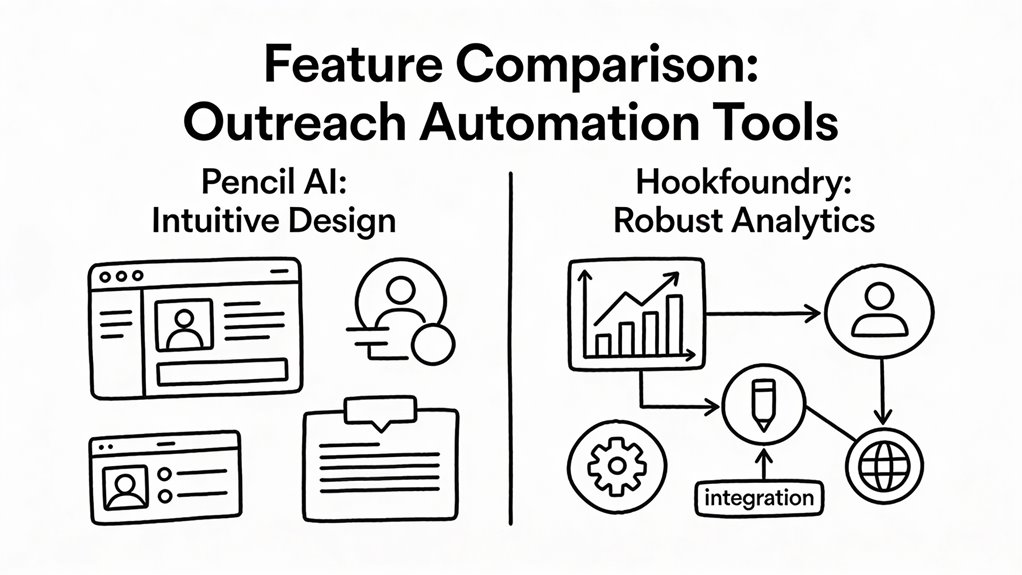
Even though we’re enthusiastic about sizing up how Pencil AI and Hookfoundry stack up in automating outreach sequences, the truth is, we hit a bit of a research wall. Without concrete data, we can’t fully gauge their outreach strategy alignment or automation tools effectiveness.
Still, innovation enthusiasts like us know the importance of exploring possibilities, so here’s a conceptual table to spark your curiosity:
| Feature | Pencil AI (Unknown) | Hookfoundry (Unknown) |
|---|---|---|
| Sequence Customization | ? | ? |
| Multi-Channel Outreach | ? | ? |
| AI-Driven Follow-ups | ? | ? |
| Analytics & Reporting | ? | ? |
| Integration Capabilities | ? | ? |
We recommend staying tuned as more observations emerge!
Prospect Database Search and Filtering Features Compared
When this matter pertains to prospect database search and filtering, the difference between a scattergun approach and a sniper’s precision can make or break your lead gen success. We see Pencil AI shining with its advanced search algorithms that plunge profoundly into ICP profiles using natural language, refining lead segmentation flawlessly.
Hookfoundry, meanwhile, impresses with filter customization and database integration, pulling contacts from 16+ providers, ensuring stellar data accuracy and contact sourcing. Both utilize competitive analysis and user feedback to evolve, but Pencil’s AI excels at parsing company websites for intricate targeting, while Hookfoundry’s waterfall validation model enhances engagement rates by 50%. In the end, mastering these features changes raw data into a precision-guided prospect list, turning innovation into opportunity for our lead gen strategy.
Lead Qualification and Enrichment Capabilities
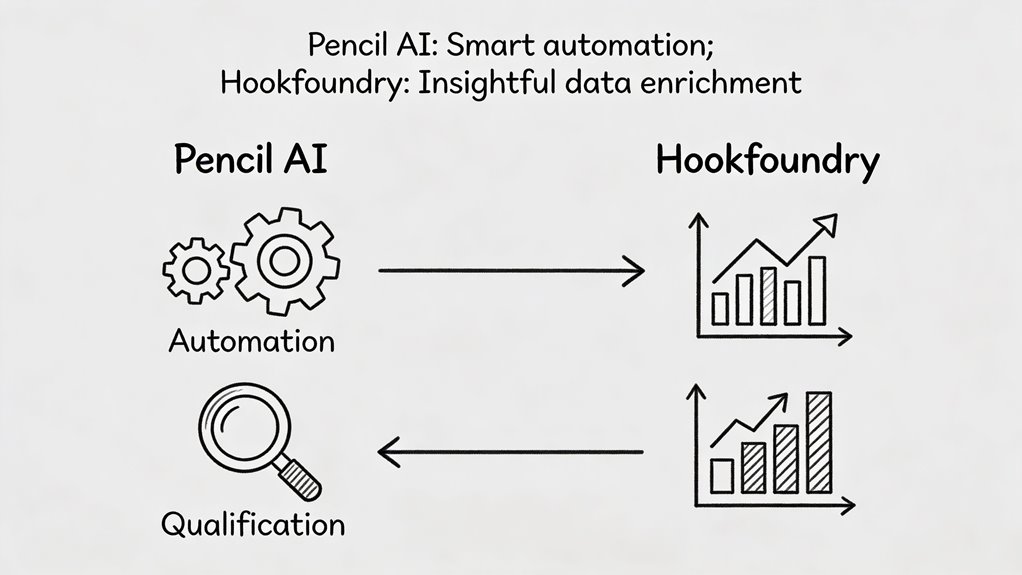
Although lead qualification and improvement can feel like steering through a maze, mastering them sets the foundation for any successful lead gen campaign. When it comes to lead scoring, Pencil AI doesn’t have an explicit system, focusing more on creating AI-driven ad creatives instead.
In contrast, Hookfoundry integrates flexible scoring models that utilize firmographic and behavioral data, continuously refining target accuracy. Data enhancement is where innovation truly shines: Hookfoundry pulls real-time observations from LinkedIn, Clearbit, and Apollo, enriching leads with company size, revenue, and job titles. Pencil allows CSV uploads and brand environment but stops short of profound lead-specific enrichment. Together, these capabilities help you not just gather leads but qualify and prioritize them smartly, fueling a sales pipeline that’s both efficient and primed for growth. Leveraging the most effective creative engines for insurance can significantly amplify lead acquisition success.
User Experience: Workflow, Interface, and Ease of Use
Sales teams and marketers know that even the best lead data won’t do much if the tools we use for working with this aren’t smooth or intuitive. Pencil AI shines here, pioneering a dialog-based chat workflow that consolidates ad creation, predictive scoring, and editing in one interface. Its onboarding process and user training are optimized, backed by continuous user feedback. This enhances productivity metrics.
Meanwhile, Hookfoundry leaves us guessing, with little info regarding workflow, feature limitations, or customization options, and no clarity regarding accessibility standards.
| Feature | Pencil AI | Hookfoundry |
|---|---|---|
| Workflow | Chat-based, automated stages | No workflow details |
| User Interface | Intuitive single chat flow | Undocumented interface |
| Ease of Use | Simplified, minimal tool-switching | No data on ease |
| Customization | Strong options, real-time editing | Unknown |
| User Feedback | Actively incorporated | Insufficient data |
Recent data underscores the impact of synthetic media in boosting sales close rates, further emphasizing Pencil AI’s potential advantage.
Integration and Compatibility With Sales Tools
Since integrating smoothly with the tools we already depend on can make or break our lead generation success, exploring how Pencil AI stacks up in that area is essential. Pencil excels with strong sales tool integrations, offering smooth CRM synchronization through platforms like HubSpot and Salesforce via Zapier and Make. This indicates creative generation can be triggered directly from CRM events, keeping our sales workflows agile and automated.
Beyond CRM, Pencil’s API and enterprise-grade support enable us to customize workflows and integrate real-time performance data effortlessly. Unlike competitors who juggle manual uploads, Pencil’s direct ad platform connections drastically reduce friction. For innovative teams seeking tight integration and efficient lead gen, Pencil isn’t just compatible, it’s a strategic force multiplier. Its ability to boost media buying with automated product-focused video creation strategies further amplifies campaign performance and lead generation outcomes.
Pricing Plans and Value for Small Businesses
When this circumstance arises regarding pricing plans and worth for small businesses, Pencil AI clearly comprehends the challenges that solo entrepreneurs and growing teams face. Pencil AI pricing starts affordably at $14/month, providing 50 ad generations, perfectly balancing lead gen advantages with small business affordability. In contrast, Hookfoundry value remains unclear, lacking transparent pricing or free trials, leaving many innovators hesitant.
Pencil AI offers clear, affordable pricing tailored for small businesses, unlike Hookfoundry’s unclear cost structure.
Here’s why Pencil AI excels:
- Scalable plans suit solo entrepreneurs to teams, with a $55/month Growth plan for higher volumes.
- A 30-day free trial and starter package diminish risk for cautious budgets.
- Pencil AI enhances campaign performance by 17%, doubling ROAS and slashing CPA.
- Predictive reflections assist small businesses compete with industry giants smartly.
For lead generation, Pencil AI offers more clarity, value, and innovation for cost-conscious businesses.
Strengths and Weaknesses for Lead Generation Strategies
Exploring the strengths and weaknesses of Pencil AI and Hookfoundry reveals fascinating revelations into how each tackles lead generation with distinct strategies. Pencil AI shines with profound pencil integration, enhancing ad creative optimization through predictive analytics and quick, data-driven observations.
Hookfoundry offers riveting customization by mechanizing tailored outreach, yet struggles with genuine human touch, causing robotic vibes. Here’s a quick emotional snapshot:
| Aspect | Pencil AI | Hookfoundry |
|---|---|---|
| Creativity | Efficient but less unique | Tailored but robotic |
| Speed | 10x quicker ad creation | Mechanized campaigns |
| Integration/Customization | Strong pencil integration | Hookfoundry customization |
| Human Feel | Limited, templated | Lacks empathy, impersonal |
| ROI | High via analytics | Low without human oversight |
Innovation seekers will appreciate Pencil’s data finesse, while Hookfoundry beckons customization lovers craving scale.
Ideal Use Cases: When to Choose Pencil AI or Hookfoundry
Let’s look at when email outreach efficiency calls for Hookfoundry’s smooth CRM integrations and real-time syncing, or when LinkedIn campaigns thrive with its rapid prospecting workflows. At the flip side, Pencil AI shines by fueling high-volume creative ads across multiple channels. This is perfect if you want a visual pipeline enhancing lead capture. Choosing the right tool depends on your prospecting focus: are you chasing intent signals with Hookfoundry or scaling ad creativity with Pencil AI?
Email Outreach Efficiency
Because efficient email outreach can make or break your lead generation efforts, choosing the right tool is crucial. When we talk about email customization and outreach mechanization, Pencil AI and Hookfoundry each shine uniquely. Pencil AI’s AI Sequence CoPilot builds campaigns swiftly from prospect lists, with hyper-personalized content scored in real time for deliverability.
Hookfoundry, nevertheless, enhances efficiency across channels, blending emails with LinkedIn and SMS in one workflow. Here’s what stands out:
- Pencil AI mechanizes profound personalization with subject line and opener generation.
- Hookfoundry enables rich creative touches like GIFs and branded visuals.
- Pencil AI offers A/B testing to fine-tune sequences without effort.
- Hookfoundry’s multi-channel mechanization accelerates engagement beyond emails.
Together, they redefine how we innovate lead gen via smarter outreach.
LinkedIn Campaign Advantage
When this relates to LinkedIn campaigns, the game changes significantly from email outreach, demanding a sharper focus regarding creative scale and precision targeting. Pencil AI shines here, offering state-of-the-art LinkedIn targeting tools with automated creative generation, including video and image ads crafted from simple text briefs.
Its predictive performance scoring, grounded in data from over a billion dollars in ad spend, accelerates campaign optimization, enabling us to foresee results before launch. Additionally, enterprise-grade features enhance approvals and automate publishing, keeping agency workflows tight. Meanwhile, Hookfoundry falls short, lacking LinkedIn-specific AI capabilities or integration, making it an ill fit for innovative LinkedIn lead generation. So, if you want agile campaign optimization and razor-sharp targeting for LinkedIn, Pencil AI is the obvious champion in today’s evolving, lead-driven environment.
Prospecting Channel Focus
In exploring the diverse environment of prospecting channels, two distinct players, Pencil AI and Hookfoundry, stand out, each customized for different lead generation strategies and team needs. Pencil AI excels in rapid, text-prompt-driven prospect revelation and sequence automation, perfect for startups craving zero-manual-effort conversion.
Meanwhile, Hookfoundry thrives upon multi-channel optimization, integrating profoundly with CRMs, LinkedIn, and email for signal-led prospecting. Choosing between them comes down to your approach:
- Opt Pencil AI for swift, AI-enriched outreach with minimal admin burden.
- Lean into Hookfoundry to utilize fragmented stacks and signal-rich B2B data.
- Use Pencil for high-volume, sequence-focused campaigns.
- Prefer Hookfoundry when personalization at scale across channels is key.
Each tool offers innovative prospecting strategies designed for unique team demands, pick what fuels your growth engine best!
What Users Say: Customer Reviews and Effectiveness
Let’s plunge into what users are saying about Pencil AI and Hookfoundry, especially when it comes to lead generation and effectiveness. User feedback for Pencil AI highlights its powerful performance metrics: over 1,000,000 AI-generated ad creatives for 5,000+ brands stand as proof of its scalability and precision. Its predictive scoring and smooth integration with top ad platforms earn it praise for enhancing creative workflows.
Conversely, Hookfoundry remains a ghost in the area of reviews and data, with no user ratings or lead gen success stories available, making it tough to gauge its impact. For innovators craving proven results and actionable observations, Pencil AI stands out with measurable performance, while Hookfoundry requires more transparency before catching up. When choosing, those performance metrics speak louder than silence!
Frequently Asked Questions
How Secure Is My Prospect Data With Pencil AI and Hookfoundry?
We trust Pencil AI’s strong compliance standards and data encryption to protect your prospect data, ensuring innovation without risk. Hookfoundry, nonetheless, lacks clear security measures, making Pencil AI the safer choice for state-of-the-art lead generation.
Do Pencil AI or Hookfoundry Offer Mobile Apps for On-The-Go Access?
We don’t see mobile access or dedicated app features for Hookfoundry, but Pencil AI offers strong browser-based mobile access, letting us innovate while traveling with its full suite of creative tools and real-time observations right from our devices.
Can Either Platform Support Multi-Language Lead Generation Campaigns?
We know multi language support enhances campaign effectiveness, and Pencil AI delivers it with 48+ languages. For Hookfoundry, we’ve discovered no data yet. We’ll keep pushing to reveal more innovation-driven observations for you.
What Customer Support Options Are Available for Each Tool?
We’ve found that Pencil AI offers live chat options and detailed support documentation, while Hookfoundry lacks these. If rapid, innovative assistance and thorough resources matter to you, Pencil AI clearly leads in customer support.
Are There Any Hidden Fees Besides the Listed Subscription Prices?
We don’t believe in hidden fees—subscription transparency is key. While overages apply for extra usage beyond quotas, pricing comparisons show these charges are clear upfront, helping you innovate without surprise costs hindering your lead gen efforts.